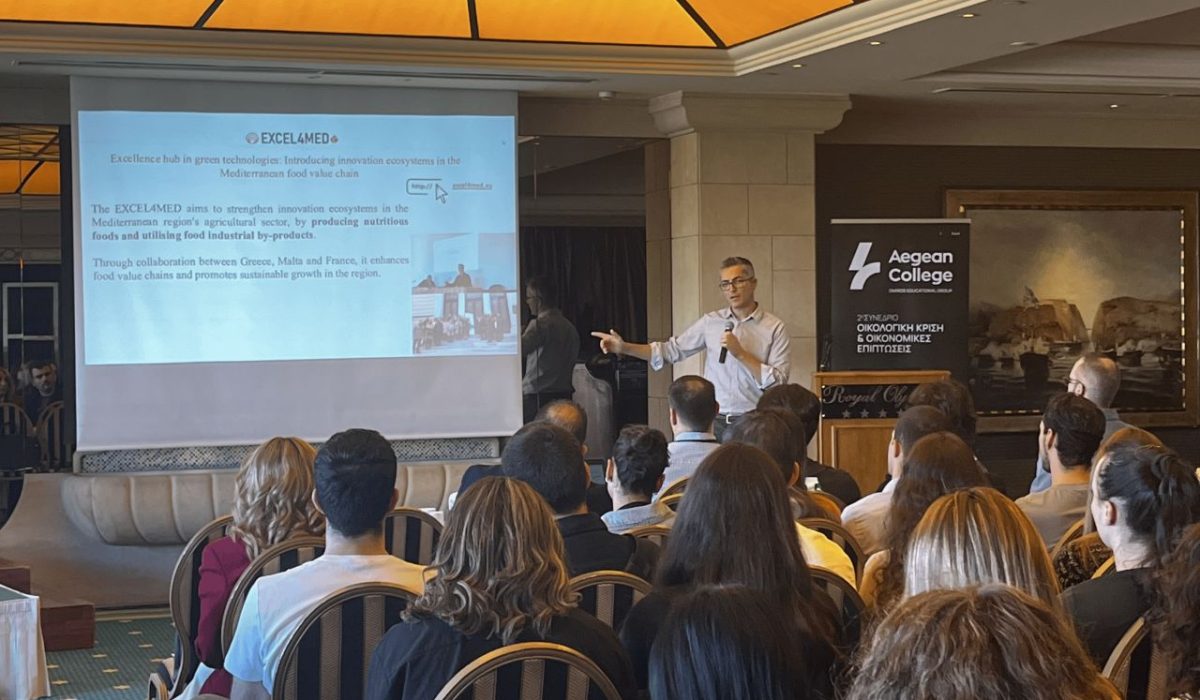
EXCEL4MED was presented at the 2nd Conference “Ecological Crisis & Economic Impacts: Adaptation, Innovation & Resilience”, held on 30 October 2025, and organised by the School of Biosciences and the School of Business Administration of Aegean College in Athens (Greece).
The conference gathered around 100 attendees, including leading voices from academia, government, industry, and civil society, for a high-level dialogue on sustainable growth and environmental resilience.
The event was held under the auspices of the Ministry of Environment & Energy and our partner the Region of Attica. Its aim was to explore the multi-layered relationships between the climate crisis, technological innovation and sustainable, resilient economic growth.
Conference focus and key themes
This year’s conference focused on several critical areas:
Adaptation to the Climate Crisis: Strategies & Policies – exploring measures to mitigate and adapt to climate-related risks.
Circular Economy & Sustainable Innovation – promoting sustainable practices and technological solutions in both public and private sectors.
Water, Energy & Food: The Triangle of Crisis – highlighting the interconnected challenges of resource management.
Climate Justice & Social Inequalities – examining how environmental challenges disproportionately affect vulnerable populations.
Natural Disasters & Climate Impact: The Cycle of Interaction – analysing the environmental and societal consequences of extreme events.
Economy of the Climate Transition – addressing economic strategies to support resilience and sustainable development.
Through applied examples, modern research data and risk management strategies, the conference served as a hub for dialogue and knowledge exchange between scientists, policymakers, businesses and active citizens, aiming to shape policies and practices for a sustainable and resilient development model.
EXCEL4MED’s contribution
Representing EXCEL4MED, our partner Thanos Karvounis from Smart Agro Hub presented the project’s approach to fostering innovation and resilience in Mediterranean fruit supply chains.
Thanos highlighted how EXCEL4MED supports sustainable production, circular economy practices and value creation for both producers and consumers. His presentation also demonstrated how EXCEL4MED is contributing to building high-value, resilient agricultural systems in the Mediterranean region.
In conclusion, this conference provided an opportunity for EXCEL4MED to engage with a diverse audience, and it reinforced the importance of integrated approaches to climate adaptation, circular economy and sustainable growth, linking research, innovation and practical strategies.